
The Divine Comedy
From Exile to Pilgrimage: Freedom, Desire, and Truth
in Dante's Masterpiece
A Seminar Series with
Matias Sur, PhD
Transformative Ideas Program
Duke University
Join us for our monthly seminar series exploring Dante Alighieri's Divina Commedia — an epic journey through Hell, Purgatory, and Paradise that has captivated readers for over seven centuries. Many have approached the poem focusing on its theological, philosophical, political or literary message. Yet beneath these readings lies a simpler and more enduring question: how does an aimless wanderer become a pilgrim?
Every human life begins as a journey. Some remain wanderers. Others become pilgrims. Dante’s poem traces the passage from wandering in a dark and foreboding forest to walking a path with direction, purpose and hope.
Written during Dante’s own exile from Florence, the Commedia transforms exile from a condition of displacement into a pilgrimage of meaning. It reveals that the deepest human journey is not merely from one place to another, but from confusion to understanding, from disordered desire to rightly ordered love, and from wandering without direction to the discovery of one’s true home.
Together we will accompany Dante through each stage of that journey. We begin with the Inferno, his harrowing descent into the underworld and a profound exploration of everything that can go wrong in a human life. We then ascend the mountain of the Purgatorio, where hope, healing and conversion replace despair as souls learn to love rightly. Finally the Paradiso draws us into a realm of increasing light and beauty, where truth and joy and divine love bring the entire pilgrimage to its fulfillment. Our journey with Dante is above all an education in freedom, desire, and truth.

This is the earliest known portrait of Dante Alighieri, who died in 1321. Attributed to Giotto circa 1334,
the fresco may be viewed at the
Bargello Palace, Florence, Italy.
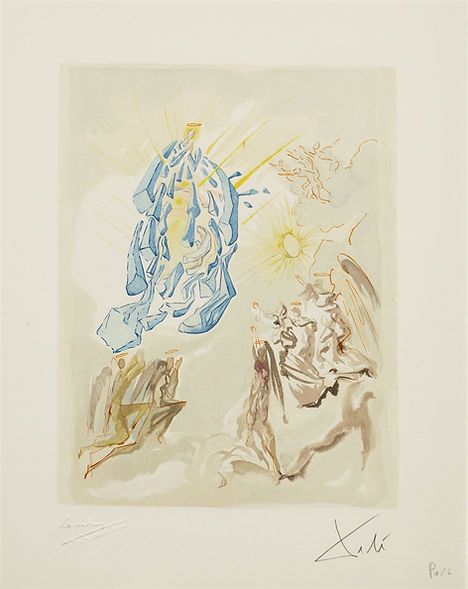
Discover one of the greatest works in world literature -- a poem that has inspired artists, writers and film makers, poets and philosophers since the poem's completion around 1320. Featured below are watercolors of the Commedia by Salvador Dali, commissioned to mark the 700th anniversary of Dante's birth in 1265.
Our monthly gatherings offer an accessible yet intellectually rigorous introduction to Dante’s masterpiece: its historical context, poetic brilliance, and enduring relevance to questions of justice, love, exile, and the human condition. More than a masterpiece of medieval literature, the Divina Commedia invites every reader to become a pilgrim. In following Dante's path, we may discover that the goal of every pilgrimage is not simply to arrive at a destination, but to become the kind of person who is truly on the way home.

Thursday ~ September 10, 2026
The Inferno
Founder & CEO
HENDERSON ROOM
MICHIGAN League
6:30 PM
Thursday ~ October 8, 2026
Purgatorio
ROOM 2210
MICHIGAN UNION
7:30 PM

Thursday ~ November 5, 2026
Paradiso
KUENZEL ROOM
MICHIGAN UNION
6:30 PM
Matias Sur

Matías Sur is a research fellow in the Transformative Ideas Program at the Kenan Institute for Ethics, Duke University. He received his PhD in Romance Studies from Duke in 2026.
His research focuses on Dante Alighieri, reception history, intellectual history, political theory, and the relationship between literature and politics. His doctoral work examined how Dante's writings — and the figure of Dante himself — have been appropriated and reinterpreted by political movements and public figures across Italy, the United States, and Argentina, revealing how each age reshapes the poet to address its own cultural and political concerns.
In addition to his scholarly work, Matías is a published poet in both English and Spanish, with poetry appearing in Half and One and Más Allá de la Palabra. He is currently working on transforming his dissertation into a book.